GateLog replaces the paper logbook at every depot gate. Every staff walk-in, every visitor's car, every contractor, every parts delivery, every bus rollout and return — captured on a rugged tablet in under five seconds, instantly visible to HQ across every depot, and ready when audit asks. The same work guards already do, made faster, more useful, and searchable.
At every depot, the guard already does the right things. They wave through known staff, ask visitors who they're seeing, check ID for contractors, stop each bus on rollout and walk through it, do the same on return. They log everything that passes the gate. The work is real and the people are doing it well — but the record lives in a notebook on the desk. HQ can't see it without a phone call. The Auditor General can't search it. The depot manager can't pull last Tuesday in under an hour.
HQ can't see who's on-site at each depot — staff, contractors, visitors — or which buses are out vs back, without calling each gate and asking. The information exists; it just isn't visible.
60+ buses at morning rollout. Staff cars arriving for shift change, contractor crews, parts deliveries, walk-ins all day long. Every one stopped, plate and name written by hand. The guard's pen becomes the bottleneck — and by the third bus, the writing gets sloppy.
Spanish Town Road has its book. Greater Portmore has its book. Rockfort has its book. A contractor refused entry at one depot can show up at another the same day with nobody knowing.
"Where was bus #247 on May 14?" requires finding the right book at the right depot, then flipping pages. Government and internal audit requests turn into multi-day projects, and the answers are never confident.
Paper doesn't support "every visit by ARC Manufacturing this quarter" or "every contractor at Rockfort over 4 hours". When the data is on a page in a drawer, it can't answer questions.
A dismissed employee, a contractor flagged for cause, a vendor whose invoices stopped adding up — recognized only if the guard on duty remembers a face. There's no system-wide alert.
GateLog ships as a complete bundle: a rugged tablet, a cellular SIM, a booth mount, the software pre-configured, and ongoing support. Each depot's guard plugs it in and starts logging within five minutes. No setup, no IT department involvement, no training videos. Every entry — a staff walk-in, a contractor's vehicle, a parts delivery, a bus on rollout — uses the same fast flow on the tablet. Buses get the priority treatment: plate, driver, time, fuel level, passenger check (anyone on the bus who shouldn't be), tamper / siphon check, and the guard's visual note. Everyone else gets the right fields for their entry type.
Cellular drops in Kingston are a fact of life. The tablet keeps logging entries locally and syncs automatically when network returns. Zero data loss. The guard never knows the difference.
Plate scan auto-fills returning buses. The driver's name surfaces from history. The morning rollout of 60+ buses no longer bottlenecks at the gate. Drivers stop waiting, schedules stop slipping.
Buses on rollout: plate, driver, time, fuel level, passenger check (anyone on the bus who shouldn't be there), tamper / siphon check, visual note. Same on return. Staff cars, contractor vehicles, deliveries: same template, right fields. Walk-ins: name, destination, host. Every entry runs through the same fast tablet flow, feeds the same dashboards, gets the same audit trail.
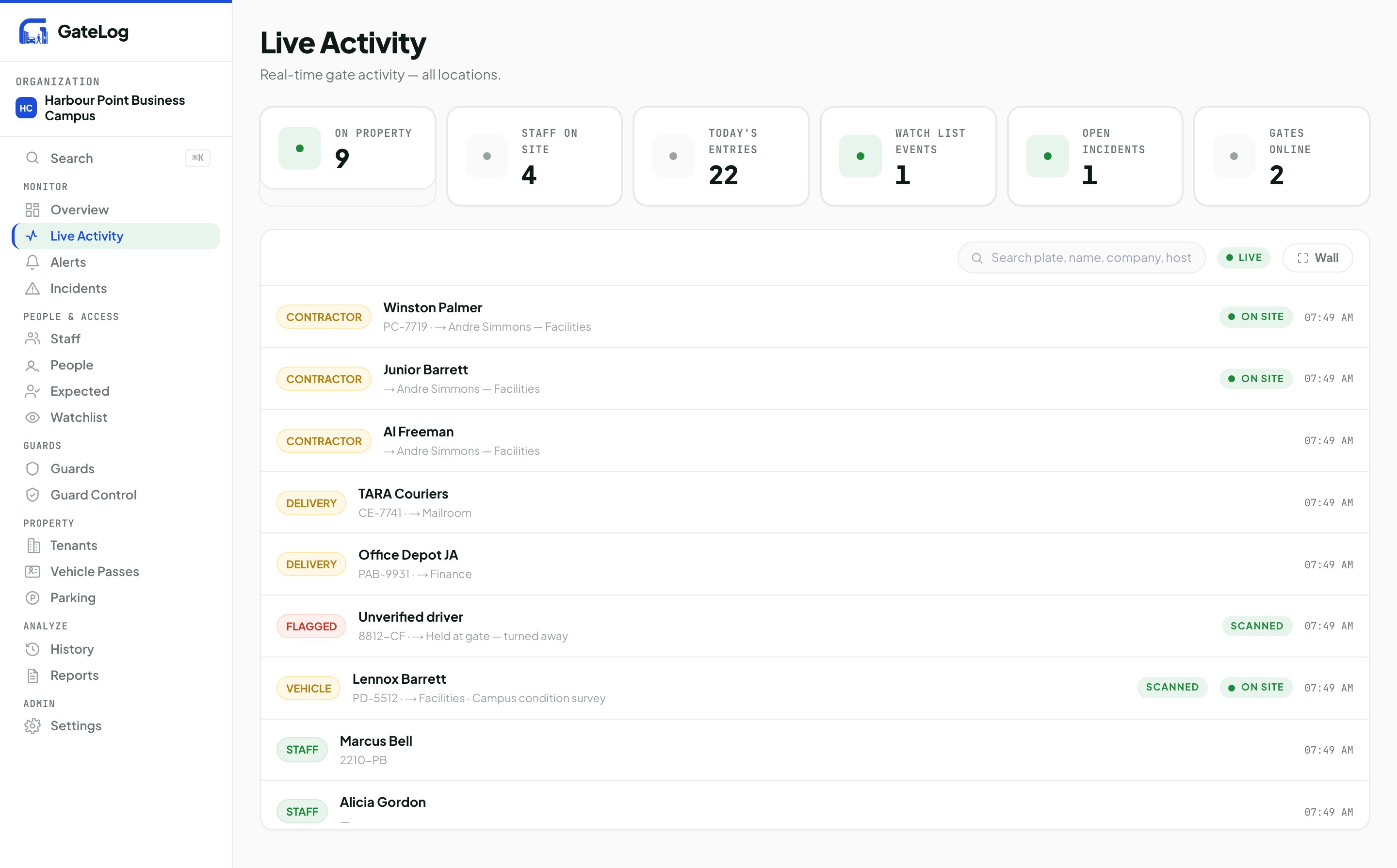
HQ sees every gate at every depot in one dashboard. Spanish Town Road, Greater Portmore, Rockfort — all live. Drill into any depot for the local view. Run reports across the whole network. The silos disappear.
Need a 90-day breakdown of contractor visits for the Auditor General? Two clicks. Need every entry by ARC Manufacturing this quarter? Two clicks. CSV and PDF exports with cryptographic timestamps.
Dismissed employees, contractors flagged for cause, vendors under review — they get flagged the instant they appear at any gate, anywhere in the network. The system makes the alert automatic instead of relying on a guard's memory.
Every entry, every edit, every export — cryptographically timestamped. Records cannot be modified or deleted, even by admins. Built to the standard of evidence government auditors expect.
Approved vendors and contractors — parts deliveries, scheduled service crews — get pre-authorized once. They show up, the gate recognizes them, they're admitted. The guard knows what's expected today and what isn't.
Once the data is digital, the logbook stops being passive and becomes an operational dashboard. Depot managers see who's on-site right now. HQ sees the live fleet across every depot. The Auditor General gets a clean answer in minutes instead of weeks. The information was always there — paper just couldn't do anything with it.
Plate, driver, time out, fuel level on departure, guard's visual-check note. Same fields on return. Every bus accounted for, with a live count of how many are out vs back.
Pedestrian entries with optional photo, name, destination, and host. Captures everyone on foot — mechanics, office staff, dispatch, audit visitors.
How many buses are out, how many returned, how many still expected back. Per-depot and across the whole network. HQ sees it without calling each gate.
Morning rollout timing, return-from-route surges, contractor windows, after-hours activity — informs staffing, security shifts, and bay scheduling.
Track which contractors are present, when they arrived, when they left, and how often. Compare against invoiced hours.
Every time a flagged contractor, dismissed employee, or watched vehicle appears at any gate. Builds documentation for HR and security review.
Pull every entry and exit for a single bus over months. Useful for accident investigation, maintenance correlation, and answering "where was bus #247 on the 14th?"
Government auditors, Ministry of Transport, internal compliance — get the answers they ask for, in the format they want, with cryptographic timestamps that hold up.
A transit operator running multiple depots, hundreds of buses, contractor crews, and government oversight needs more than a visitor logbook — it needs live operational visibility across the network. GateLog is designed for exactly this shape of operation.
Spanish Town Road, Greater Portmore, Rockfort — every gate at every depot reports into one HQ dashboard. Depot managers see their site. HQ Operations sees the network. The Auditor General sees what they ask for, when they ask.
Kingston cellular isn't always reliable. Industrial areas drop. Hurricane season interrupts. GateLog's tablets keep working offline with zero data loss, syncing the moment connection returns. The guard never knows there was an outage.
Buses on rollout and return get the priority treatment — plate, driver, time, fuel level, passenger check, tamper / siphon check, visual note — captured in seconds. The same fast flow covers everyone else: staff cars, mechanics, dispatchers, contractors, parts deliveries, audit visits. HQ sees the live fleet count and who's on-site, across every depot.
Built to the standard of evidence the Auditor General's Department and Ministry of Transport expect. Tamper-evident logs, cryptographic timestamps, exportable in the formats they accept. Government queries that took weeks get answered in minutes.
A dismissed employee can't slip in at a different depot the next day. A contractor flagged for cause is flagged across the whole network the moment they appear at any gate. The alert is automatic.
Multi-year contract with predictable per-gate pricing. Hardware included, replacement guarantees standard, training included, support standard. Designed to fit a government procurement process without awkward integration work.
JUTC's footprint — multiple depots, hundreds of buses, government oversight — calls for a tailored proposal, not an off-the-shelf monthly subscription. The proposal covers depot rollout sequencing, hardware count and replacements, training plan for guards and HQ staff, audit-ready reporting templates, and multi-year terms.
Hardware, software, cellular connectivity, training, and ongoing support — structured for a public-sector procurement and a phased deployment across every JUTC site.
We'll schedule a short site visit at one JUTC depot. We bring a working tablet so your team can see the system handle a live shift. Then we draft a proposal sized to your operation.
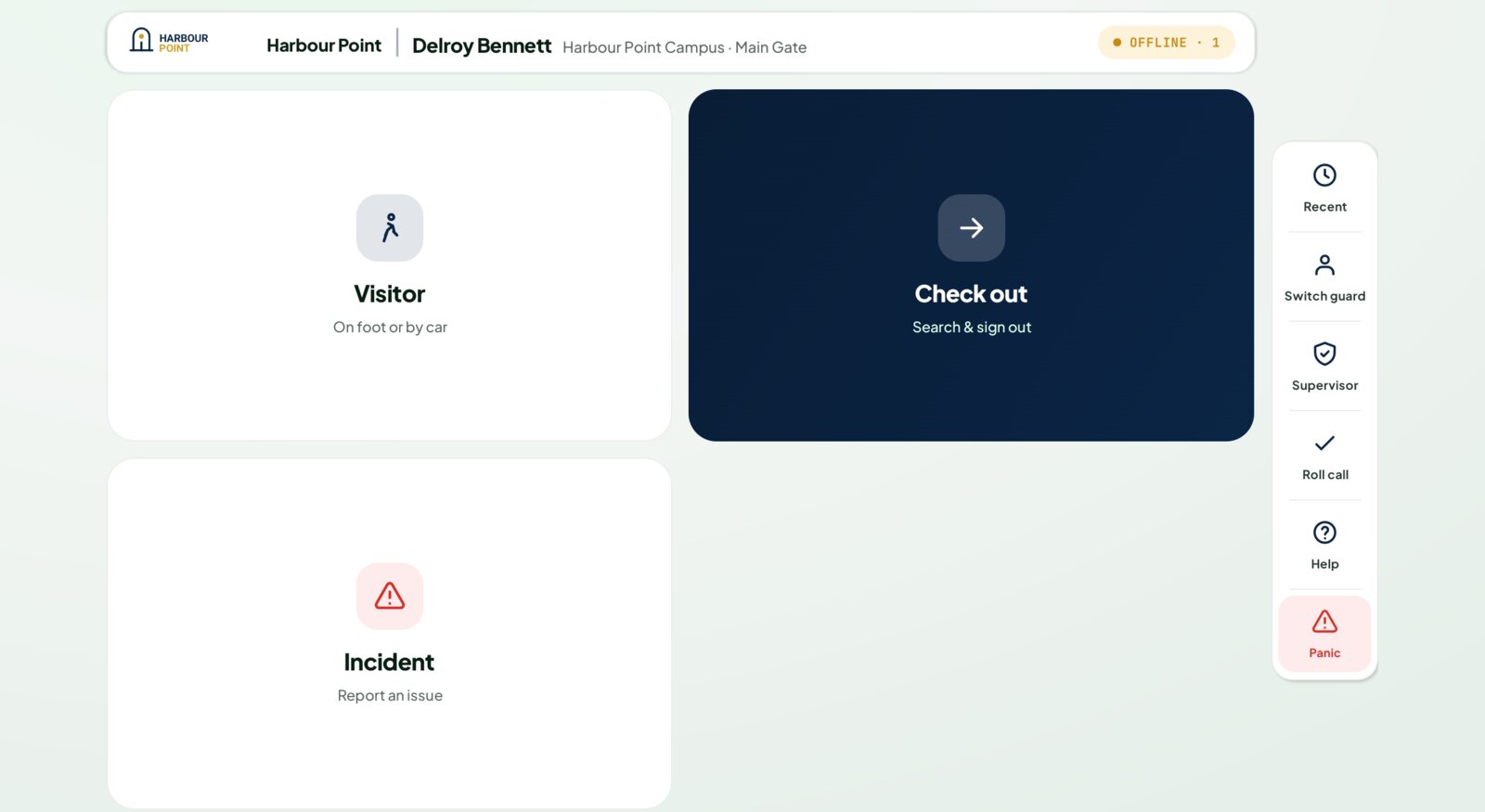
Email stackcurious@gmail.comThe eight core screens that make up GateLog — the guard tablet, the depot-contact mobile experience, and the depot manager & HQ dashboard.
The default screen. Four primary actions, live stats, and recent activity — the entire system understandable at a glance.
For every bus leaving the depot, the guard confirms the four checks they already do — captured in seconds, signed, synced. Same flow on return.
For unknown vehicles. Plate already captured. Three fields plus visit-type pills, optimized to keep the line moving.
For pedestrians, deliveries on foot, rideshare drop-offs, and contractors walking in. Optional photo capture makes checkout effortless.
The whole point of the product. Scan the plate, see the match, hit the giant button. Designed to be doable without looking.
For pedestrians leaving. Photos of everyone currently on foot inside — tap the right person and they're checked out instantly.
Browser-based, no app install required. Workshop supervisors, dispatchers, and bay heads pre-authorize expected vendors, contractors, and deliveries — and the gate admits them with one tap.
No app install required.
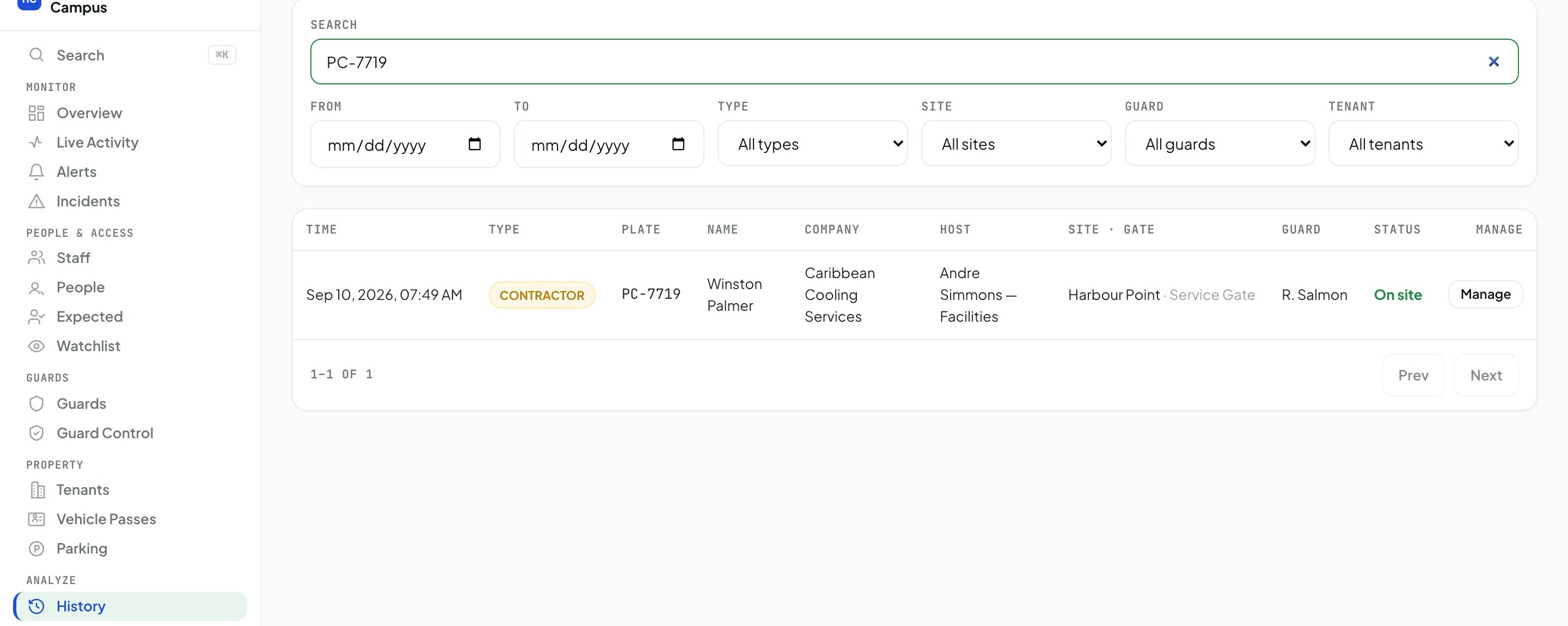
The view for depot managers and HQ operations. Live activity across all gates, exportable logs for the Auditor General, multi-depot KPIs at a glance.
Click around. Switch sidebar tabs, search the activity log, click a row for detail, add or remove watch list entries. Sample data lives in your browser — refresh resets it.
May was the busiest month on record at Spanish Town Road Depot, with 5,847 total movements across all four gates — a 14% increase over April and 9% above the 12-month rolling average. Despite the higher volume, average gate time improved to 4.1 seconds (down from 4.8s in April), driven by stronger vendor pre-authorization adoption and plate-recognition auto-fill on returning buses.
Pre-authorization coverage reached 71% of expected entries (vendors, contractors, parts deliveries), up from 58% last month. Bus rollout tracking captured every departure and return with fuel level and visual-check notes — HQ now has a live view of the fleet across all depots. Watch list triggered 3 times across the network in May, all resolved at the gate. Zero unaccounted vehicles at month-end.
The busiest single day was Friday, May 24 with 312 movements, driven by month-end fleet servicing. The busiest hour across the month was 5am–7am (morning bus rollout), averaging 64 movements per hour. Sunday remains the lightest day at the depot.
| Gate | Movements | Walk-ins | Avg time | Uptime |
|---|---|---|---|---|
| STR Main Gate | 2,841 | 418 | 3.8s | 99.9% |
| STR Bus Exit | 1,943 | 12 | 3.2s | 99.8% |
| STR Service Gate | 781 | 47 | 5.4s | 100% |
| STR Pedestrian | 282 | 282 | 4.8s | 100% |
A total of 2,418 bus movements were logged at STR in May — 1,212 rollouts and 1,206 returns. Every rollout captured plate, driver, departure time, fuel level on departure, and the guard's visual-check note. Returns captured the same plus arrival time and fuel on return. Average gate time dropped from ~38 seconds (paper) to 4.1 seconds (tablet), eliminating the morning rollout bottleneck.
The watch list was triggered 3 times at STR during May. In all cases, the guard was alerted before opening the barrier, and the encounter was resolved without incident. The watch list currently contains 3 active entries (all org-wide, applying to every JUTC depot).
Audit trail integrity: All 5,847 movements are encrypted at rest with cryptographic timestamps. 7 records were exported this month — including the Auditor General's quarterly review pack — all by authorized HQ staff with logged justifications (see Audit Log for detail). Photo retention is at 87 days of 90 configured.
Pre-authorization coverage reached 71% this month, exceeding the operational target of 65%. 14 of 17 active vendors are now on the approved pre-auth list. The 3 holdouts (one occasional cleaner, two infrequent specialists) have been flagged for paperwork follow-up.
| Metric | This month | vs last month |
|---|---|---|
| Pre-auths created | 641 | ↑ 42% |
| Recurring vendor entries (auto-recognized) | 1,847 | ↑ 58% |
| Avg contractor on-site duration | 2h 18m | ↓ from 2h 51m |
| Vendors with active pre-auth | 14 of 17 | ↑ from 9 of 17 |
System uptime was 99.88% across all STR gates this month. The only unplanned downtime was a 47-minute window on May 14 (STR Service Gate) due to a cellular outage; the tablet operated in offline mode and synced 84 queued entries upon reconnection. No data was lost.
Eleven HQ staff actions were logged this month: 2 watch list additions (one HR-driven, one finance-driven), 4 depot contact updates, and 5 data exports including the Auditor General quarterly pack. Full detail available in the Audit Log section of the dashboard.
Total entries, exits, peak times, and on-site averages across all gates.
Download PDF ›Every entry and exit, exportable for compliance, audits, and legal requests.
Download CSV ›Per-gate KPIs: avg entry time, throughput, sync uptime, guard activity.
Download PDF ›Frequency, hours on-site, repeat visits — flag unusual contractor patterns.
Download CSV ›All triggered watch list events, with timestamps and gate locations.
Download PDF ›Which vendors and contractors use the pre-auth system, frequency, and approval adoption trends.
Download CSV ›Basic details about this depot and its gates.
Control which events generate alerts to managers.
How long visitor logs and photos are kept.
Subscription and hardware status.
Push a message to every guard tablet across the depot network. Appears as a banner on their screen until acknowledged or expired.
You're about to view identifiable entry history for a specific depot contact. This action will be logged to the audit trail.